Sovereignty-as-a-Service (SaaSx)™  | Digital Territory Division™

The Digital Territory Protocol™ for Organizations Claiming Their Name, Data, and Power

 
In the next evolution of the internet, control will be defined not by who has the most data, but by who holds the sovereign keys to their digital namespace.
The Digital Territory Protocol™ is the strategic governance framework that transforms a generic domain into a defensible jurisdiction for your brand’s identity, assets, and institutional authority.

Your domain is not just an address; it is the deed to your digital territory. In the next internet, the most valuable asset won’t be the land—it will be the sovereign right to govern it. – Sophia Bekele

This is not a domain registration. It is a geopolitical maneuver for your brand

Scroll to continue ↓

The .Africa Precedent: Why Structure Determines Outcome 


The .Africa top-level domain case became one of the most consequential governance examinations within the global internet coordination ecosystem.   The decade-long battle for the .Africa domain was not a technical failure. It was a masterclass in governance stress test. 

We won a precedent-setting victory at ICANN’s Independent Review Process, proving the bylaws were violated. Yet, we were blocked from a fraud trial in U.S. court by a procedural technicality—Judicial Estoppel.

This is the unseen risk for every dotBrand and community applicant: winning on merit can be nullified by a system designed to protect itself.

The .Africa top-level domain case exposed a fundamental truth about global digital infrastructure governance.  In multi-layered governance systems:

• Accountability mechanisms can validate violations
• Procedural doctrines can override substantive merit
• Political alignment can shape application trajectory
• Governance blind spots can nullify technical excellence

The .Africa case stands today as a documented governance stress test — and a structural warning for the 2026 application round.

Merit alone does not determine outcome. Governance architecture does.

The case demonstrated how procedural architecture can override substantive victory.
— Sophia Bekele


Sovereignty I must be architected before application.
This is not theoretical.
It is institutional precedent.  It is a published case study.

Read the definitive account on Circle ID: Eight-Year Legal Battle Recap: DCA Blocked From Being Heard on Its Merits 

ICANN & Governance archive →  

Applicant Advisory Series: Preparing for the Next gTLD Round


More to follow..
 

Diagnostic Module
DotBrand Sovereignty Audit™

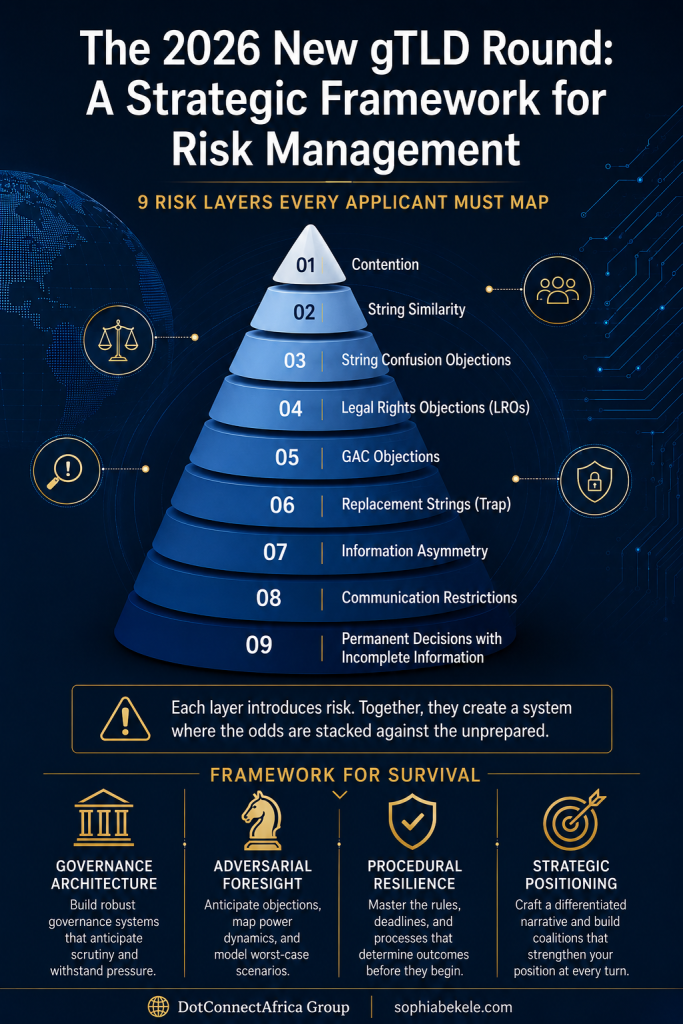
A Targeted Diagnostic for Serious 2026 Applicants

We apply the same forensic framework across:

  • Stakeholder & Adversary Mapping
    Who — internally or externally — could derail your application? We identify pressure actors, rival interests, and political choke points before they mobilize.

  • Procedural Resilience Testing
    We assess readiness against ICANN accountability mechanisms (IRP, Reconsideration), formal objections, and geopolitical escalation scenarios.

  • Governance Architecture Design
    We structure the internal legal, technical, and communications command model required to withstand the full ICANN lifecycle — not just the application window.


Your Counter-Playbook

While others manage application forms, we engineer structural resilience.
A dotBrand without sovereignty architecture is a strategic liability.

Is your dotBrand a target?
 👉 Pressure-Test Your Strategy — Take the 5-Minute DotBrand Sovereignty Audit
 

Stop outsourcing your sovereignty. Let’s pressure-test your systems before they become a strategic liability. 


AEGIS Architecture © Sophia Bekele. All rights reserved — sovereignty doctrine for the AI era.