.Africa Commentary Series
A living archive of analysis, precedent, and warning from the architect of the .AFRICA domain.
The .africa top-level domain exists today. But the story of how it was conceived, contested, and eventually delegated is not just history—it is the playbook for understanding how institutional power protects itself in the Internet governance ecosystem.
This series gathers analysis, documentary evidence, journalist coverage, and ongoing commentary on the .africa case and its implications for the 2026 gTLD round and beyond.
They closed the courtroom door. They could not close the record. –– Sophia Bekele
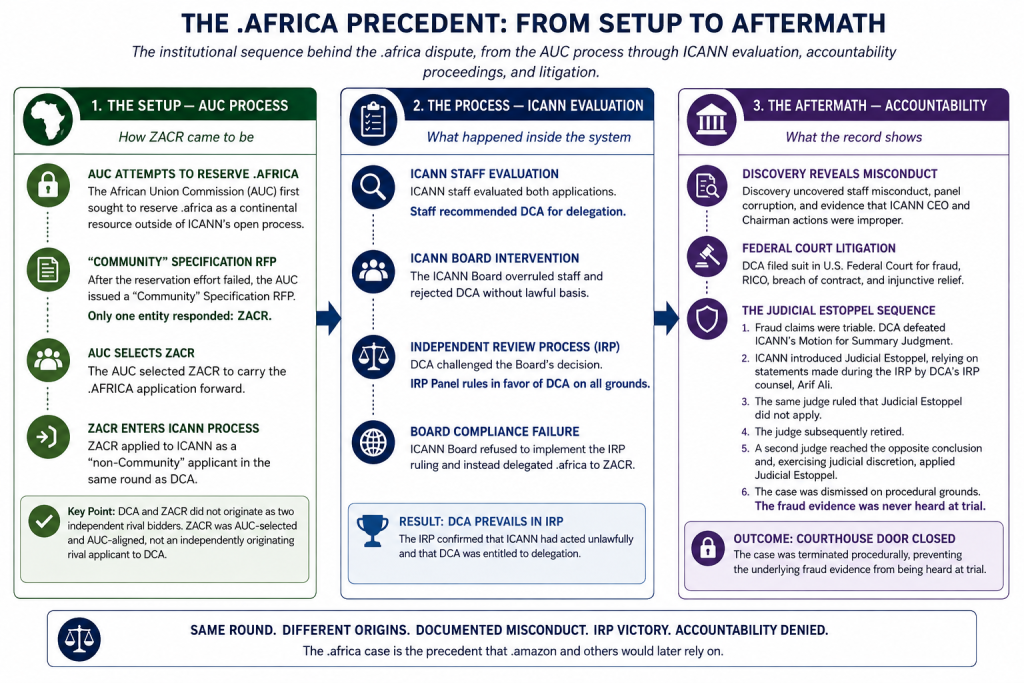
DotConnectAfrica Trust (DCA) and ZACR did not originate as two independent rival bidders for .africa.
- DCA independently pursued .africa through the ICANN process.
- The African Union Commission first attempted to reserve .africa as a continental resource and, after that effort failed, created a “Community” Specification RFP in which only ZACR participated.
- The AUC selected ZACR, which subsequently entered ICANN’s Applicant Guidebook process as a “non-Community” applicant.
Same ICANN round. Different origins.
ZACR was AUC-selected and AUC-aligned, not an independently originating rival applicant to DCA.
Why This Series Exists
The .africa case established a precedent that .amazon and others would later rely on. An Independent Review Process was won. Staff misconduct was documented. Panel corruption was revealed. The actions of the ICANN CEO and Chairman were exposed.
The courthouse door did not close because DCA’s fraud claims failed on their merits. DCA defeated ICANN’s Motion for Summary Judgment on the fraud-related claims, and the case was headed to trial. ICANN subsequently introduced Judicial Estoppel, relying on statements made by DCA’s IRP counsel, Arif Ali, during the IRP:
“These proceedings will be the first and last opportunity that DCA Trust will have to have its rights determined by an independent body. DCA and other gTLD applicants, the IRP is their only recourse; no other remedy is available.”
The same judge ruled that Judicial Estoppel did not apply. The judge subsequently retired. A second judge reached the opposite conclusion and, exercising judicial discretion, applied Judicial Estoppel and dismissed the remaining case. The case was therefore terminated procedurally, preventing the underlying fraud evidence from being heard at trial.
This is not a grievance. It is a governance stress test—and a warning for every applicant entering the next round.
Featured Commentary
Estoppel Blocks Courts, Not History: The .africa Case (February 2026)
A deep dive into the procedural doctrine that closed the courtroom door—and why the record survived anyway.
[Read the full article →]
The AUC’s Role in Blocking an African Applicant—Then Losing the Domain (Coming Soon)
How the African Union Commission was advised by ICANN staff and board members to oppose .africa, and how they later lost control of the very domain they sought to reserve.
What Discovery Revealed: Staff Misconduct, Panel Corruption, and a CEO’s Rewritten Endorsement (Coming Soon)
A look at the evidence that never saw trial—and what it reveals about institutional accountability.
Fifteen Years Later: What the 2026 Round Must Learn from .africa (Coming Soon)
The capstone essay, tying every lesson to the risks applicants face today.
The .Africa Commentary Series
.A deep dive into the precedent, the procedural war, and what the 2026 round must learn. (LESSONS FOR THE 2026 gTLD ROUND)
How ICANN Turned Internet Expansion Into a Toll Booth – Governance Theater: Why the gTLD Expansion Program Is a Lose-Lose Proposition. The truth is this: the gTLD expansion program is not a market. It is a toll booth. This is not an argument agianst applying It is an argument against entering the system without understanding its economics.
Whose Precedent Gets Remembered? Selective Amplification Has Its Own Amnesia – How .africa Became the Legal Foundation for .amazon win. Why the .africa IRP ruling matters far beyond the continent—and how it shaped the rules for the 2026 round.
FIFA, ICANN and the TLD Trap: What Every 2026 gTLD Applicant Should Know Before Entering the Game
Kenya Lost .africa. Here Is the Story The Citizen Kenya Left Out – Kenya already had a chance at an African domain. It did not end well.
- Did the AUC-Aligned ZACR Actually Deliver .africa? – A decade of data, a rigged process, and the architect’s unanswered questions.
- Estoppel Blocks Courts, Not History: The .africa Case – How a procedural doctrine closed the courtroom door, and why the record survived anyway.
- The IRP Docket Speaks Louder Than Theory – A Response to Charles Mok on ICANN and AI Governance
- When the Registry Itself Is Contested: The Unseen Geopolitical Risk in the 2026 gTLD Round
- The 2026 String Similarity Guidelines: Automating the Mistakes of the Past
- Preparing for the Next Round of New gTLDs: Governance and Resilience Lessons for Applicants ( SSRN)
- ICANN’s Accountability Crisis: How WSIS+20 Exposes Decades of Failed Oversight
- Same Playbook. New Battlefield – Why I Stand With Burkina Faso’s Rev – Mirrors .Africa, IDNs
- Eight-Year Legal Battle: Why DCA Was Blocked From Being Heard on the Merits
Key Historical Record
The institutional sequence behind the .africa dispute, from the AUC selection process through ICANN evaluation, accountability proceedings, and litigation.
.AFRICA Document Archive
All primary documents related to the .africa case—including the IRP ruling, court filings, and discovery materials—are publicly available in the .africa domain history archive →
About the Author
Sophia Bekele is a Digital Sovereignty & Governance Strategist and the Founder of DotConnectAfrica Trust. A former ICANN gNSO Council policy advisor (2005–2007) and co-author of the gTLD Applicant Guidebook, she was the lead claimant in the precedent-setting .africa IRP case. Her work sits at the intersection of institutional governance, digital rights, and strategic risk.
For Journalists and Researchers
This series is a living resource. If you are covering the 2026 gTLD round, ICANN accountability, or digital sovereignty in Africa, and would like access to documents, interviews, or context, please contact me →
Stay Updated
New commentaries are added as the 2026 round unfolds.
Subscribe to The Ethical Technocrat For ongoing .africa commentary →

AEGIS Architecture © Sophia Bekele. All rights reserved — sovereignty doctrine for the AI era.