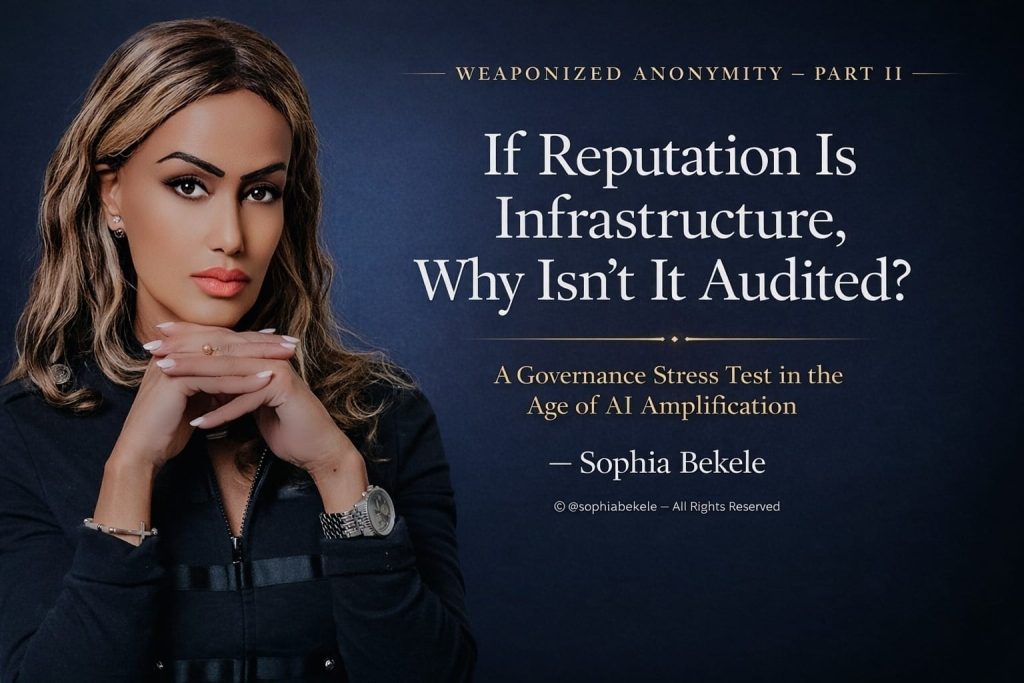
March
Late last year, I wrote about Weaponized Anonymity— how unverified digital signals scale faster than verification mechanisms.
Recently, I watched that thesis play out in real time.
An anonymous claim surfaced.
It was indexed.
It was amplified.
It was ingested by AI systems
It began shaping perception —and causing real-world damage.
Evidence was submitted.
Documentation preserved.
The platform refused.
Then — without notice, without disclosure, without audit transparency — the content disappeared.
No correction log. No apology. No audit trail. No visible accountability trail.
That is the governance gap.
Silent correction is not governance. It is containment.
In the AI era, reputation is infrastructure.
-
- It can be attacked and amplified at machine speed.
- It can influence economic outcomes in hours.
- And it can be corrected — privately, while the damage lingers
Cyber systems log intrusions.
Financial systems log adjustments.
But AI-amplified reputation corrects in silence.
That is a structural risk.
Why are AI-amplified reputation systems exempt?
If reputation now functions as programmable infrastructure, it must be governed like infrastructure.
It then requires:
-
- Verification standards
- Escalation transparency
- AI ingestion traceability
- Board-level oversight
Containment is not transparency.
Silent correction is not accountability.
And in an AI-accelerated environment, opacity is risk.
This is not a personal dispute.
It is a control architecture issue.
The future of digital governance will not be defined by how fast AI scales.
It will be defined by whether we are willing to audit the systems that shape perception.
#WeaponizedAnonymity #AIGovernance #DigitalRisk #PlatformAccountability #ReputationInfrastructure
Sophia Bekele
Digital Sovereignty Architect | AI Governance Strategist
Founder of DotConnectAfrica Group and CBSegroup, advising on AI governance, platform accountability, and digital risk architecture