Author name: Sophia Bekele

Sophia Bekele, founder of DotConnectAfrica Trust, photographed for a 10-year retrospective Q&A on the .africa domain, accountability, and the AUC's role

Did the AUC-Aligned ZACR Actually Deliver .africa?

10 Years. 55,000 Domains. 1.5 Billion People. A Performance Review Africa Deserves — As the 2026 gTLD Round Opens. March 20,  2026 This article is part of the.africa Commentary Series — a living archive of analysis, precedent, and warnings from the architect of the .africa domain.  In July 2024, the people who took .africa gathered […]

Did the AUC-Aligned ZACR Actually Deliver .africa? Read More »

The Sovereignty Premium: Why Every Board Needs a Geopolitical Risk Committee

The old order is burning. Allies are realigning. Capital is walking. Is your board prepared? March 14, 2026:This article is part of the Governance, Democracy & Economic Policy Series → The Pattern The old assumption — that the United States would always be the center of global trade, security, and capital — is no longer reliable. We

The Sovereignty Premium: Why Every Board Needs a Geopolitical Risk Committee Read More »

A photograph of President Donald Trump speaking at a podium. Text overlay : I was not in the room, but still saw the room.

The White House Template: Claim Victory, Declare Progress, Hope No One Checks

March 29, 2026This article is part of the Governance, Democracy & Economic Policy Series → — Yet the Alliance Is Still Burning—The Children in the Room II Prologue: The Template In 2026, a pattern emerged. The U.S. president would announce a breakthrough — an ally agreeing, a deal close, a war nearly over. Within hours, sometimes

The White House Template: Claim Victory, Declare Progress, Hope No One Checks Read More »

Sophia Bekele AEGIS Architecture RSAC 2026 AI Governance

RSAC 2026 Just Handed Sovereign AI Architecture: Its Biggest Proof Point

March 28, 2026The article is part of the AI, Cybersecurity, and Risk series → The conference declared AI governance is the unsolved crisis of our time. I was at RSA Conference this week in San Francisco. Hundreds of vendors. Thousands of security professionals.Billions of dollars of product on the expo floor. And the loudest signal

RSAC 2026 Just Handed Sovereign AI Architecture: Its Biggest Proof Point Read More »

Split composition image for the article "Scientists Have Spoken. Now Who Will Build?" Left side shows scientists in a lab with holographic data. Right side shows architects at a round table, representing governance builders. Text overlay reads: "Scientists Have Spoken. Now Who Will Build?

Scientists Have Spoken. Now Who Will Build?

March 13, 2026: This article is part of the AI, Cybersecurity, and Risk Series  →  Christopher Yoo’s recent piece in the Business Times—“AI governance: The summit stage is necessary but it isn’t sufficient”—captures a moment that many in the AI policy world are feeling but few have articulated so clearly. The India AI Impact Summit was

Scientists Have Spoken. Now Who Will Build? Read More »

A glass of champagne on a coffee table with a laptop in the background, dim lighting. Text overlay reads burning alliance The Children in the Room I'm on my couch Champagne Still writing

The Children in the Room: How They Just Burned the U.S. Alliance

March 9, 2026This article is part of Governance, Democracy & Economic Policy Series → The Epstein Class Mentality — in Four Acts Prologue: The Smirk That clip went viral this month on Social Media. An Iraqi foreign minister, asked by U.S. media if he fears military invasion. Cameras rolling. Reporters leaning forward, expecting fear. He smirks.

The Children in the Room: How They Just Burned the U.S. Alliance Read More »

When Sovereignty Becomes Extortion: The Anthropic Story Every Nation Needs to Read

March 13, 2026 This article is part of Ethical Technocrat Series  → US company refused to enable mass surveillance. The government destroyed it. Zimbabwe saw the same playbook coming. So did Namibia. This is the pattern. I. The Ultimatum The Pentagon gave Anthropic a choice: remove safeguards against mass surveillance and fully autonomous weapons, or

When Sovereignty Becomes Extortion: The Anthropic Story Every Nation Needs to Read Read More »

Describes the scene for screen readers and SEO. Includes keywords naturally.

Victory Used to Mean Winning the Battle. Now It Means Leaving the Drowning

March 9, 2026Part of Governance, Democracy & Economic Policy Series → An Iranian warship was torpedoed in international waters. The US left. Sri Lanka came. The Pentagon called it a victory. I am not a war historian. I don’t pretend to know the classified briefings, the naval strategies, or the calculations made in the Pentagon’s war

Victory Used to Mean Winning the Battle. Now It Means Leaving the Drowning Read More »

Split composition image for the article "Scientists Have Spoken. Now Who Will Build?" Left side shows scientists in a lab with holographic data. Right side shows architects at a round table, representing governance builders. Text overlay reads: "Scientists Have Spoken. Now Who Will Build?

The IRP Docket Speaks Louder Than Theory – A Response to Charles Mok on ICANN and AI Governance

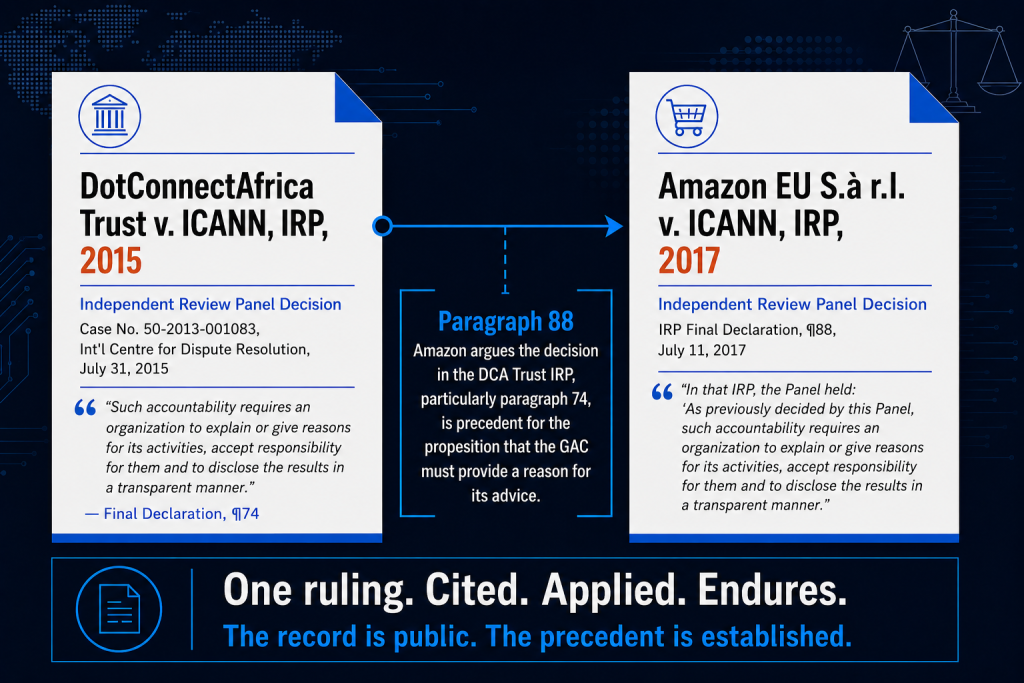
First published on CircleID — March 6, 2026Part of the ICANN & Governance Series → A Stanford research scholar asks whether the multi-stakeholder model can guide AI. The record of more than a dozen IRPs offers answers he hasn’t considered. Charles Mok’s recent CircleID article, “Do We Need Alignment Between Internet Governance and AI Governance?”,

The IRP Docket Speaks Louder Than Theory – A Response to Charles Mok on ICANN and AI Governance Read More »

Sophia Bekele on reputation as infrastructure and AI governance risk

If Reputation Is Infrastructure, Why Isn’t It Audited?

March  Late last year, I wrote about Weaponized Anonymity— how unverified digital signals scale faster than verification mechanisms. Recently, I watched that thesis play out in real time.  An anonymous claim surfaced. It was indexed. It was amplified. It was ingested by AI systems  It began shaping perception —and causing real-world damage. Evidence was submitted.Documentation preserved.The

If Reputation Is Infrastructure, Why Isn’t It Audited? Read More »