Published First on Linkedin
Part of the ICANN & Governance Series
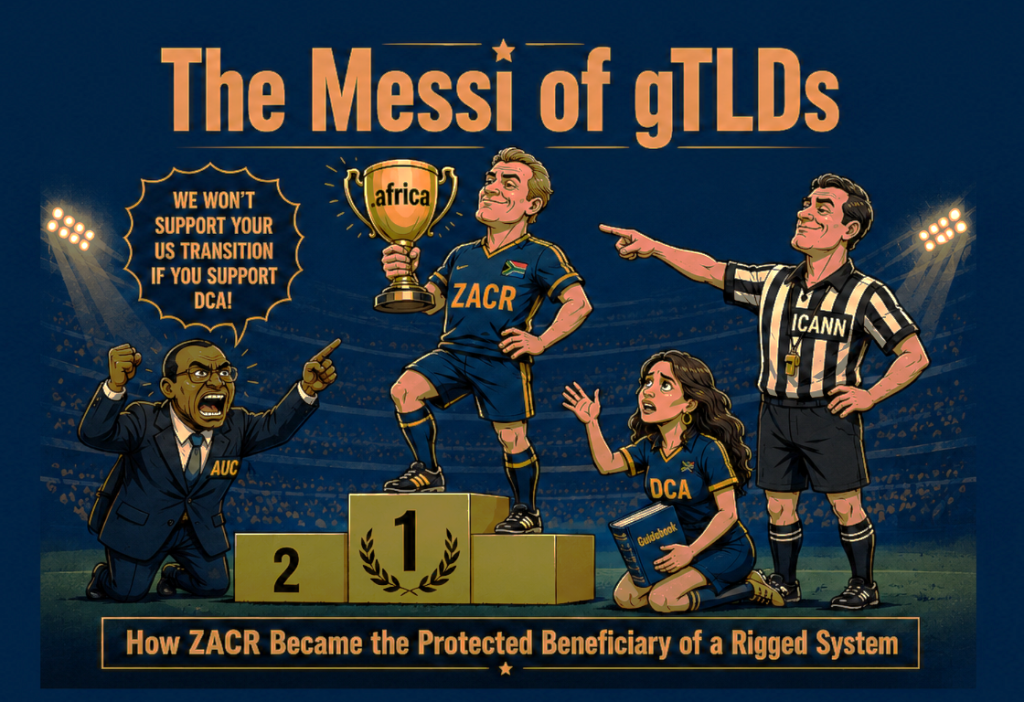
ICANN in the Public Square Again | Part II
Gianni Infantino is in trouble.
After his failed plan to commercialise the World Cup, UEFA and several major European federations withdrew their support. He is now counting on the Confederation of African Football’s 54-member bloc to keep him in power.
Africa is being courted. Not served. Courted.
It is the same pattern we have seen before. When an institution is under pressure in the West, it turns to Africa for the numbers.
ICANN did it during the IANA transition. Between 2014 and 2016, ICANN was locked in a geopolitical battle for its survival. The ITU and the broader UN system were pushing hard for intergovernmental control of the internet. ICANN’s entire model, private sector led, multistakeholder, self-governing, was under challenge. It needed African governments in its corner. The AUC’s 54-member bloc was not a courtesy. It was a shield. African governmental support through the GAC was leverage in an existential fight over who would govern the internet.
ICANN got that support. Africa got ZACR, a protected beneficiary.
Infantino is running the same play now.
In football, that pattern produces a protected player. In internet governance, it produced a protected registry.
This is how .africa was won. And lost.
And this is how ZACR became the Messi of gTLDs.
In the world of football, there are players who are celebrated for their talent and discipline. And then there are those who are protected, who operate above the rules, whose failures are ignored, whose shortcomings are excused, and whose success is manufactured by the institutions that benefit from their presence.
There is one important difference, of course. At least Messi performed.
In the world of Internet governance, ZACR is that player.
Today, the Mauritius-based Registry.Africa, operated by ZACR, controls the continental .africa domain.
The Clean Applicant
DotConnectAfrica was the clean applicant. We were endorsed by the African Union Commission and the UN Economic Commission for Africa. We followed every rule. We had the technical capacity, the financials, and a six-year global campaign. We were ready to deliver.
We continuously asked to engage the AUC. We reached out, offered collaboration, and sought a way forward. The AUC never responded. What followed was not simply the AUC keep its silence on the support it gave DotConnectAfrica Trust (DCA) and chose ZACR. The AUC first moved to reserve .africa as a “continental resource”. When that failed, it ran its own Community Specification RFP, selected ZACR, and entered into an arrangement with ZACR concerning rights and control over .africa. ZACR then entered ICANN’s process as a non-community applicant.
ZACR was never an independent applicant to be considered a competator to DCA.
That arrangement was not hidden. It was disclosed in ZACR’s own ICANN application, and DCA raised it in public comments. ICANN knew about the relationship and allowed ZACR’s application to proceed. Yet after DCA later won the IRP and its endorsement was found valid, ICANN sent DCA back to that same AUC for an updated endorsement.
DCA’s endorsement was valid. ICANN nevertheless demanded an “updated” endorsement from the institution already contractually aligned with ZACR. They didn’t fix the process. They moved the goalposts.
ZACR was the AUC’s choice, with the bureaucracy behind it, a relationship that would later surface directly in court proceedings and depositions.
The Protected Beneficiary
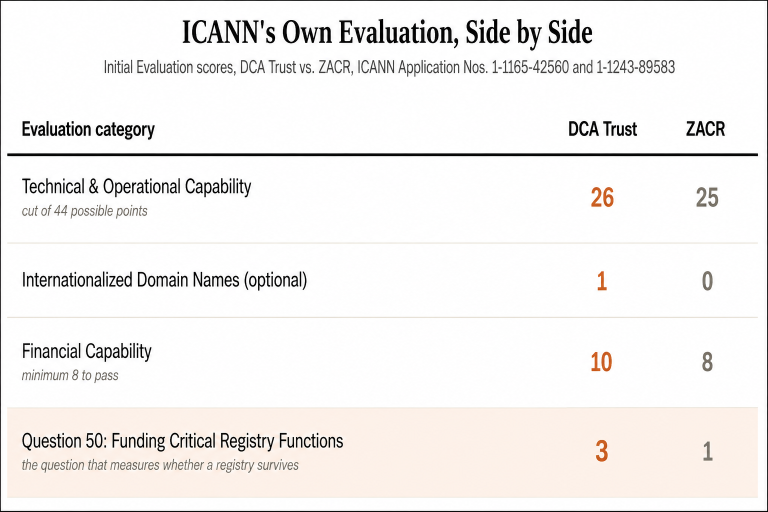
But ZACR was never the strongest applicant. They were never the most qualified. Their technical capacity was lower, their financials were weaker, and their endorsement documentation failed to satisfy the Geographic Names Panel requirements. But they were protected. They became the prime beneficiary of two corrupt processes: the AUC process that selected them and the ICANN process that kept them alive.
When ZACR’s endorsement documentation ran into trouble, ICANN staff intervened. The replacement endorsement mirrored the exact type of endorsement DCA had received years earlier, after I clarified the requirements with the AUC Chairman’s office. The record surrounding that intervention later became part of the controversy exposed through the unredacted IRP materials.
Then consider the sequence. The AUC tried to reserve .africa. When that failed, it ran its own RFP and selected ZACR. ZACR emerged from a “Community Specification RFP” but applied to ICANN as non-community.
Its endorsement documentation encountered problems and ICANN intervened. The AUC continued opposing DCA. GAC advice was used against DCA. DCA challenged ICANN and won the 2015 IRP. Our endorsement was found valid. Yet ICANN resumed our application through Extended Evaluation and demanded an updated endorsement from the same AUC already contractually aligned with ZACR.
Had both applications been allowed to survive evaluation, the Applicant Guidebook already had a process for resolving contention between applicants, potentially culminating in auction. DCA never got there.
At what point does an exception stop being an exception and become the system?
The Dual Quid Pro Quo
ZACR was not just protected. They were rewarded. Their arrangement with the AUC concerning rights and control over .africa went considerably beyond an ordinary governmental endorsement. Again, this relationship was disclosed in ZACR’s own application. DCA publicly commented on it. ICANN had it sitting in front of them.
Yet ICANN ignored that relationship when allowing ZACR to proceed, then turned around and required DCA to obtain an updated endorsement from the institution already aligned with ZACR. That was the setup, not a neutral process.
There was another alignment operating in parallel. ICANN was pursuing its historic transition away from U.S. government oversight. The AUC represented an important continental governmental constituency. ZACR needed the AUC. The AUC wanted its chosen structure for .africa. ICANN needed governmental support for its global transition. DCA stood outside that alignment insisting that the Applicant Guidebook be followed.
The result was a closed loop. DCA followed the rules. ZACR broke them. And the institutions that were supposed to enforce the rules, ICANN and the AUC, instead became the referees for ZACR, just like FIFA has been for Messi and Argentina.
That is why I call it a dual quid pro quo. The interests converged around one applicant, while the applicant outside that arrangement was repeatedly blocked.
DCA No Campaign: Their Instruction Manual
DCA had sought to explain the endorsement requirements to the AUC years earlier. Through the different stages of what we watched, the AUC was consistently confused about the ICANN process. First came the attempt to reserve .africa. Then the RFP. Then the selection of ZACR. Then an applicant selected through a Community Specification process entered ICANN as non-community.
ZACR never explained the process to them. Why? Because they could simply wait to become the beneficiary of whatever process emerged.
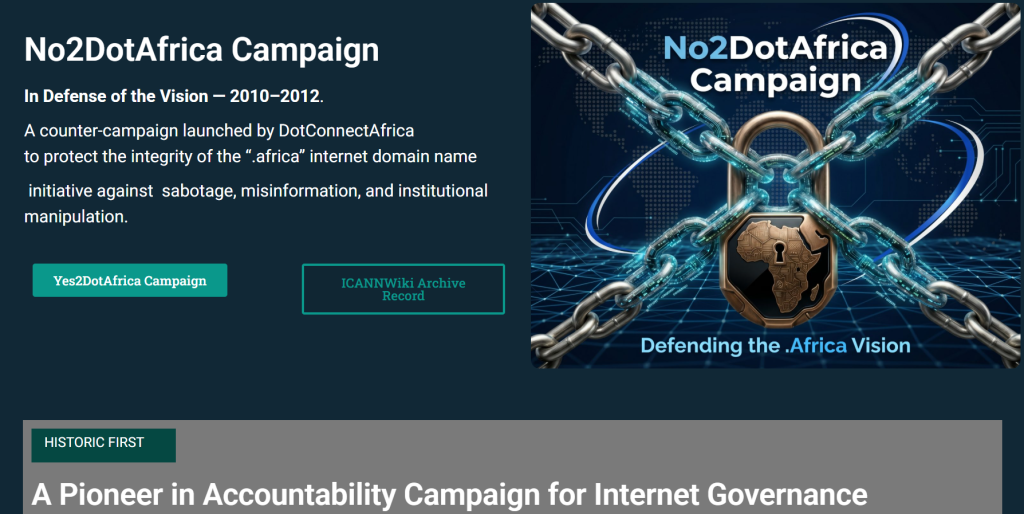
They waited for DCA, the “she.africa,” as ICANN’s CEO once called me, to explain the ICANN process. That is why our No Campaigns were so effective. The AUC and ZACR read our materials and shifted their position as we exposed the procedural problems. Our No Campaign became their instruction manual.
The full record of the No Campaign remains preserved in the DCA No2DotAfrica Campaign archive.
The “she.africa” label was not an accident. It was a dismissal. ICANN’s CEO referred to our organization, a registered corporation, as “she,” despite the fact that we had more than 16 board advisors across Africa and the world and a full operational staff supporting our application. I corrected him publicly, in writing, the same week he made the statement. The label stuck anyway.
It became shorthand for how the system saw us: an applicant to be dismissed, not taken seriously. A single woman making noise. That exhibited the culture at ICANN, nothing more. I wrote about it at the time in CircleID: “Thank You GNSO, From the ‘She.Africa’”.
ICANN staff themselves did not always appear to understand the rulebook either. Much of the machinery is outsourced: evaluation panels, objections, auctions and other processes are handled by contractors operating under specific Applicant Guidebook procedures. But when an issue arose, like ZACR’s endorsement problem, suddenly ICANN staff became involved.
The referees were no longer simply enforcing the rules. They were becoming part of the game.
That is not governance. That is a system in which the rules can bend depending on who needs rescuing.
Four Strikes
The conflict of interest was not the only problem. ZACR also lacked DCA’s financial strength and comparable technical profile for the undertaking.
Their principal registry experience was running the country-code TLD .za, a fundamentally different operation from building and operating a continental gTLD. Their application rating was lower than DCA’s in important areas documented in the ICANN evaluation records. Even in their ccTLD operations, subsequent performance issues emerged around their South African registry arrangements.
Conflict of interest.
Financial incapacity.
Lack of gTLD experience.
Contract-performance problems.
Four strikes. They should never have been selected.
Yet they got .africa.
The Receipts
Now comes the next act: rewriting the history through ICANNWiki.
ZACR is increasingly presented as though it were simply an independent applicant competing on equivalent terms with DotConnectAfrica. But an institution selecting a supplier through its own process, entering into an arrangement concerning the domain with that supplier, opposing another applicant and supporting its selected supplier is not independent competition.
If ZACR was so independent from the AUC structure, then the AUC should have had the confidence to endorse multiple applicants, even three or four, and let them compete on their merits. Instead, it selected one, supported one and opposed the other. Even the courts later confronted the conflict of interest involving the AUC-ZACR relationship.
We know what happened. We have the receipts: more than $2 million worth of evidence, IRP proceedings, depositions, court filings, public comments and application records documenting how the system operated.
And then there was the cover-up. When ICANN’s handling of the ZACR endorsement became an issue in the IRP, portions of the record were redacted. When the unredacted IRP material emerged, the staff involvement surrounding the rewriting of ZACR’s endorsement documentation became visible. The ICANN industry knows this history because the controversy was reported at the time.
Now the next stage is quieter: rewrite the institutional history through ICANNWiki until an AUC-selected, AUC-aligned registry looks like an ordinary independent competitor.
They are not just rewriting history. They are erasing the No Campaign and the accountability lessons ICANN, the AUC and ZACR themselves took from it. The record is being quietly revised while the new players are busy placing their bets.
The Conflict Was Built Into the Model
ZACR did not enter .africa as a neutral continental registry operator. Its established business was rooted in South Africa’s .za namespace, including .co.za. DCA warned from the beginning that placing Africa’s continental gTLD in the hands of an incumbent national ccTLD operator created a structural conflict: the same operator would be responsible for developing both an established national namespace and a new continental competitor.
Years later, the performance gap makes that warning impossible to dismiss as theoretical.
The question is no longer whether the conflict could exist. It is whether Africa has now lived with its consequences.
The Result
After a decade, .africa has roughly 55,000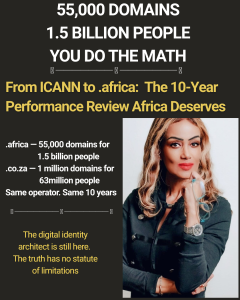 domains. But approximately 25,000 of those were generated through the awareness and demand created by DCA’s campaign. The organic growth is roughly 3,000 domains per year.
When we exposed the 55,000 performance, their website revised the language to speak of an “aspiration” of 100,000 registrations. At the current organic growth rate, that target remains many years away.
For a continent of approximately 1.5 billion people, that is not growth. That is a rounding error.
WHY IT MATTERS:
Because after all the politics, all the institutional maneuvering and all the effort expended to make sure one applicant got .africa and the other did not, performance is where the argument eventually has to land.
The Verdict
The system was rigged. The outcome was manufactured. And the beneficiary was protected.
ZACR did not simply beat DCA in an ordinary competition. It emerged from an AUC process, entered ICANN’s process carrying that institutional alignment, survived a succession of interventions and exceptions, and ultimately received .africa after DCA’s application was eliminated.
DCA later spent years in court. The litigation ultimately ended through Judicial Estoppel without our underlying substantive claims being heard on their merits. That procedural ending did not erase the documentary record. It did not erase our IRP victory. And rewriting ICANNWiki cannot erase it either.
The system was supposed to enforce the rules. It was not supposed to choose the winner.
In football, even the favored player eventually has to score the goal.
Show Us the Money, The Impact
There is another part of the .africa performance story that deserves scrutiny: the money.
If .africa was awarded and promoted as a continental and community resource, Africa should be able to see the economics behind it: registry revenues, operating expenditures, marketing expenditures, community investments, distributions and how much was actually reinvested in growing the namespace across the continent.
There is an irony here that should not be lost to history. During the original debate, DCA Trust, a non-profit applicant, was accused of seeking to “hijack” .africa, despite the enroumous amount of money, time and resources we spent for a global awarness campaign, after securing and endorsment from AUC and UNECA.
Fifteen years later, the more relevant question is: who actually captured the “continental resource”, and who has benefited from it?
After nearly a decade and roughly 55,000 registrations, where was the sustained Africa-wide marketing? Where was the investment in building demand? Where is the measurable community impact?
Those questions matter because weak performance raises another governance question: has .africa become a vehicle for rent-seeking rather than continental development?
A registry cannot indefinitely point to operating expenses as evidence of stewardship while producing limited market impact. Financial disclosure would allow the African community to distinguish between the cost of administering .africa and actual investment in developing it.
If the public-interest story is real, show the impact. If the stewardship is sustainable, show the investment. If the money is being spent developing .africa, show the books.”
A NOTE FOR THE HISTORICAL RECORD
ZACR was not a conventional independent “rival” bidder to DCA for .africa.
The AUC first sought to reserve .africa as a continental resource. After that effort failed, it created its own “Community” Specification RFP, in which only ZACR participated, and selected/appointed ZACR. The AUC and ZACR then entered into an agreement concerning rights to .africa. ZACR subsequently entered ICANN’s Applicant Guidebook process as a “non-Community” applicant.
DCA, by contrast, had independently pursued .africa through the ICANN application process. The two applications eventually appeared in the same ICANN round, but they did not originate as two independent competing bids.
Same ICANN round. Different origins. ZACR was AUC-selected/ Appointed and AUC-aligned, not an independently originating “rival” bidder, as they want to be seen.
Call to Action
The story of .africa should not end with who was handed the contract. It should end with whether that choice delivered for the African community the AUC said it was acting on behalf of.
The AUC created a restricted Community Specification RFP around what it presented as a continental resource. Fifteen years later, one basic question still deserves an answer:
Who exactly was the “African community” this model was supposed to serve?
Was it Africa’s 54 countries, 1.5 billion people and one continental domain, the vision DCA championed through its six-year Yes2DotAfrica campaign? Or was it the narrower “community” constructed through the AUC’s RFP?
After nearly a decade and roughly 55,000 .africa registrations, where is that community in the results?
The new leadership of the African Union and ICANN should convene a public hearing or independent review of .africa covering its selection, performance, finances, marketing, reinvestment and measurable community impact. Full financial disclosure should be part of that accounting.
ZACR should account publicly. DCA should be heard on the record. The AUC and ICANN should account for their respective institutional roles.
If the stewardship has not delivered, it should not be treated as permanent. Africa has every right to reconsider who should carry .africa forward.
Fifteen years later, Africa deserves more than an inherited decision. It deserves an accounting.
If the African community was the justification for .africa, then the African community must also be the measure of its success. Show us the promise, the performance and the proceeds.
Promise. Performance. Proceeds.
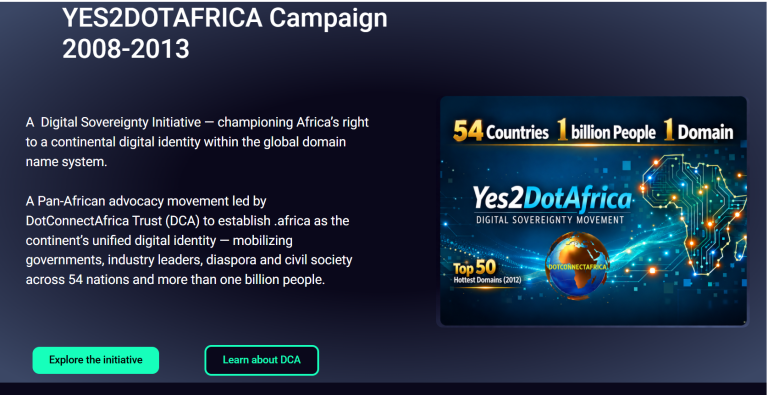
For the documented record behind the .Africa case — from the AUC process and ICANN evaluation to the landmark IRP victory, litigation, and its continuing governance implications — visit the .Africa Commentary Series.
More in this series to follow. ICANN is now in the public square.
#FIFA #ICANN #TLDTrap #GTLD #GovernanceRisk #DotConnectAfrica
Sophia Bekele — ICANN gTLD Policy Advisor (2005–2007) | Author, Black Swan Moments: Nerves of Steel | ⚽ FIFA, ICANN and the TLD Trap — What ICANN, Consultants, and Lawyers Won’t Tell You.
Subscribe to The Ethical Technocrat →
The Counter-Playbook for leaders navigating power, platforms, and institutional risk