The Epstein Class Mentality — in Four Acts
Prologue: The SmirkThat clip went viral this month on Social Media. An Iraqi foreign minister, asked by U.S. media if he fears military invasion. Cameras rolling. Reporters leaning forward, expecting fear. He smirks. “Let them come.” Not bluster. Not bravado. Just… certainty. The calm of someone who knows something the questioners don’t. That clip is going viral because we’re watching that same certainty play out — in real time, with higher stakes, and the same people still not getting it.
Act I: “Iran wouldn’t strike back.”
The Trump administration gathered in the Oval Office. Intelligence briefings were laid out. Maps were studied. And somehow, in that room, no one asked the obvious:“What would we do if someone struck us first?”They assumed Iran wouldn’t respond. Not because of deterrence. Not because of intelligence. But because of something simpler: arrogance. The assumption that “thinking people” live only in certain countries. That the other side isn’t prepared. Iran had prepared for exactly this moment. When the U.S. struck, Iran followed its preconceived strategy. They retaliated with drones and missiles — drones that cost a fraction of what the U.S. spends to shoot them down. They drained U.S. and Israeli air defenses. They hit ports, banks, airports, data centers. Dubai’s gleaming airport — a place I’d walked through many times — reduced to rubble and evacuation alarms. The children in the room were surprised. The rest of us weren’t.
Act II: “Gulf allies wouldn’t walk.”
The alliance was built on a simple bargain: oil for security. For fifty years, it held. Then the U.S. struck Iran without consulting its Gulf allies. Without warning them. Without considering that their airports, their oil facilities, their desalination plants would become targets. The Gulf states watched their infrastructure burn. They watched U.S. missiles fly from bases on their soil — and realized: we’re paying for a war we never approved.Now they’re discussing something unthinkable: a trillion-dollar withdrawal from the U.S. economy. Saudi Arabia, UAE, Kuwait, Qatar — sitting together, reviewing contracts, considering force majeure clauses, asking whether their billions are funding peace or war.The proof arrived quietly this week. The FII PRIORITY Miami summit speaker list was updated. The two most powerful Saudis — Yasir Al-Rumayyan, who controls the $900 billion Public Investment Fund, and Finance Minister Mohammed Al-Jadaan — are no longer listed. They sent diplomats and a tourism minister instead. The decision-makers stayed home. The children in the room assumed petrodollars meant permanent loyalty. They were wrong.
Act III: “Capital would stay put.”
The FII PRIORITY Miami summit – which I was invited to be later restricted due to space – is happening right now. Theme: “Capital in Motion” — a celebration of cross-border investment, of American markets as the ultimate destination for global wealth. But capital is in motion away from the U.S. — $15 billion a day leaving U.S. Treasuries, a “Sell America” sentiment gripping international markets. Why? Because the fundamental assumptions have cracked:- Federal Reserve independence is under assault
- Trade wars are escalating
- The U.S. is increasingly viewed as a “developed market with emerging market risks”
But the people who move the money aren’t in the room. The Saudis sent a skeleton delegation. The Gulf principals stayed home. The Nasdaq CEO may not show.The children in the room assumed markets would absorb the shock. They’re learning otherwise.
Act IV: “The world would just accept.”
This is the oldest assumption of the Epstein class: we do what we want, and no one stops us. It worked for years — on islands, in boardrooms, in back channels. Power protected power. The rules were for other people. Now that phrase — “Epstein class” — is gaining traction across party lines. A Democratic Senate candidate in Maine says the war exposes leaders who “do not know the realities of war” while sacrificing young Americans. A Georgia Republican used the same line: “They are the elites they pretend to hate.”Rich men start wars that our kids will pay for in their blood. It won’t be the CEOs’ sons that go there. It won’t be Trump’s sons. It will be a poor kid from a trailer park.The label sticks because it’s true. The same mentality that assumed impunity in private now assumes impunity on the global stage. But the world was never in that class. It was just watching. And waiting. And planning. Now the ports are burning. The banks are hit. The airports are rubble. The alliances are crumbling. And the capital is walking. The children in the room are still asking: “Why didn’t they tell us?” They did. You just thought the smirk was a joke.
Epilogue: The View from the Couch
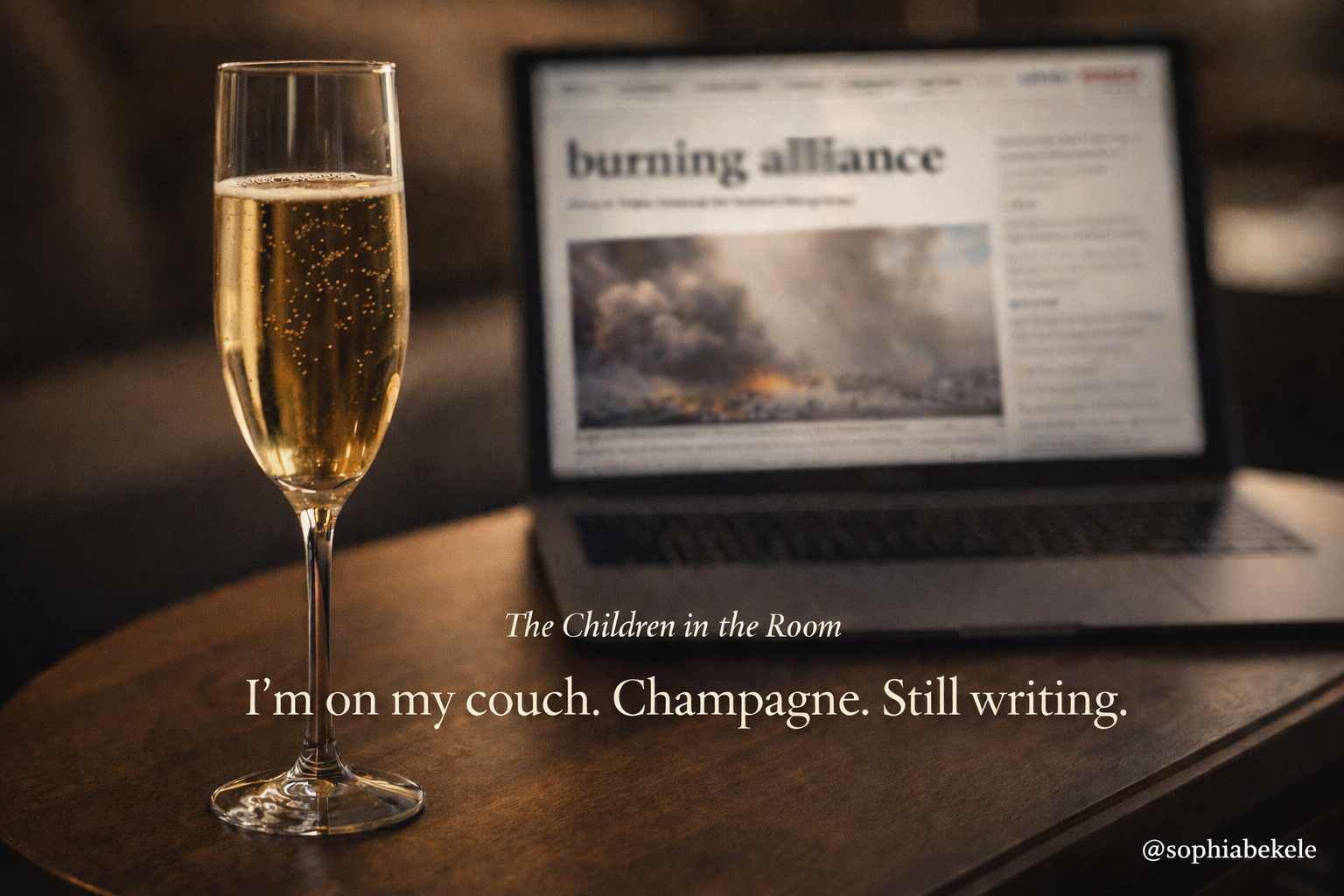
I was referred to advise the most powerful people on earth. They sent the Secret Service to ask if I hike. I said I don’t like the sun. They asked if I drink. I said: “You mean the bar behind you?” They wrote it down. They tried to scare me. Then they held a conference to celebrate the alliance they just burned down. I’m on my couch. Champagne. Still writing. — legacy built on truth, not access
#TheChildrenInTheRoom #EpsteinClass #IranWar #TrillionDollarWalkout #CapitalFlight #FIIMiami #RedSea #TheyTriedToScareMe #StillWriting #LegacyBuiltOnTruthNotAccess #WokeMajority
Sophia Bekele On Law, Governance, and the Architecture of Power
Founder, DotConnectAfrica Group & CBSegroup | Publisher, The Ethical Technocrat
Subscribe to The Ethical Technocrat → The Counter-Playbook for leaders navigating power, platforms, and institutional risk