Published Exclusively for CircleID.
Part of the ICANN & Governance Series
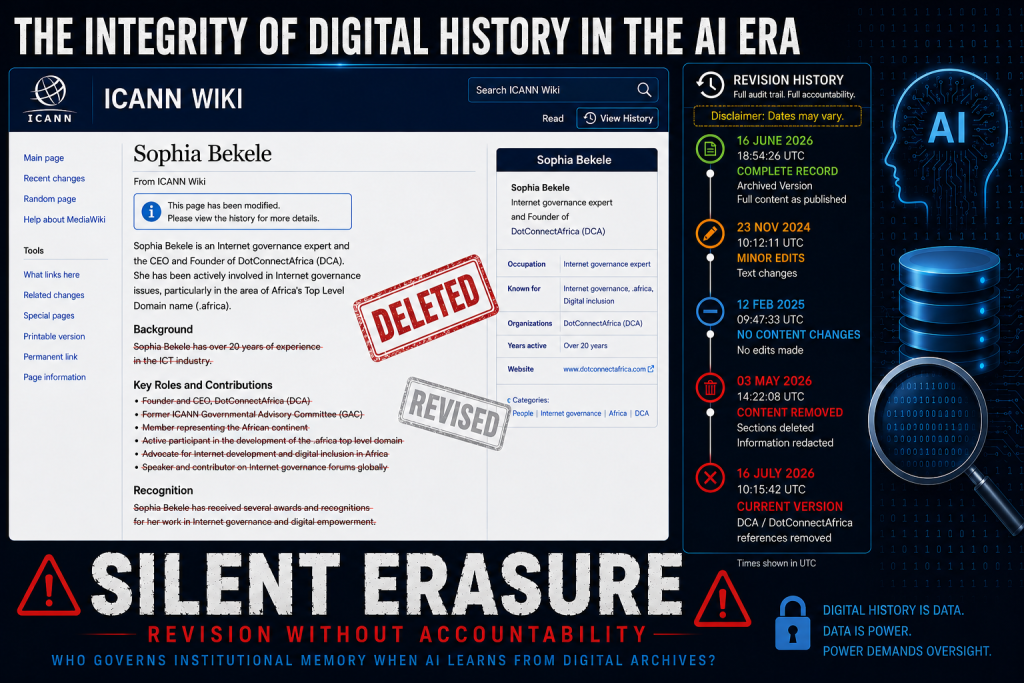
The ICANN Wiki Case Study and the Governance of Institutional Memory
The integrity of digital history is becoming one of the defining governance challenges of the AI era.
Every day, platforms edit, revise, and remove information. Most corrections improve accuracy. Some quietly alter the historical record without meaningful transparency, public accountability, or an audit trail. As AI systems increasingly rely on digital archives to understand people, organizations, institutions, and events, those editorial decisions become governance decisions.
ICANN, the institution whose own documented conduct across a decade of proceedings, panel rulings, and court findings is the subject of this record, is now represented by a platform it funds that reduces that same history to ‘participation,’ as if the individual in question were merely another attendee traveling on a government or company-paid dime. ICANN spent a decade contesting this record in panels and courtrooms.
This is the same ICANN that, during the .africa process, publicly referred to my organization as ‘SHE’ which I later reclaimed in my SHE.africa article. Now a platform it funds reduces that same record to ‘participation.
The record demonstrates otherwise.
The recent revisions to my ICANN Wiki biography provide an instructive case study.
The Case Study
The latest conduct involves ICANN Wiki, which has revised and reduced multiple ICANNWiki sites that had been stable for nearly twelve years. The revisions and deletions were not isolated. In July 2026, multiple pages, my biography, the DotConnectAfrica Trust page, and the No Campaign page- were all revised or deleted within a short timeframe.
The timing coincides with the publication of four articles that revisited documented events ICANN would prefer to forget. The ICANN Wiki biographies for Sophia Bekele and DotConnectAfrica Trust were reduced by approximately 90 percent, from 11 sections and 153 citations to 4 sections and a fraction of the original references.
If they had to reduce my record by 90 percent to make me look like a competitor, imagine how little the other side actually accomplished
Before examining the edits themselves, it is important to understand the platform behind them. ICANN Wiki has received funding from ICANN for years. Public records have documented funding exceeding US$100,000. Whatever its original purpose, it is no longer a neutral historical resource. It has become a platform that can itself be influenced by the institution it documents.
The initial revisions were not subtle. The language was dismissive and unprofessional: “unsuccessful applicant,” “failed the extended evaluation,” and other framing designed to diminish the record. Subsequent revisions, after I raised the issue, shifted tone, but the damage to the historical record had already been done. The IDN section, which originally contained four formal testimonials from the IDN Pioneers, was deleted completely, and then, after my contacting the editor, was restored and reduced to a single sentence of vague ‘public praise.’ I requested a full restoration; the editors declined and gave an option of deletion, which is perhaps along the line of what they were looking for.
ICANNWiki presents itself with the visual language of a genuine wiki platform, a “View History” tab, the appearance of MediaWiki’s open architecture. But unlike Wikipedia, which is governed by an independent nonprofit foundation with public revision logs anyone can inspect without an account, ICANNWiki is a privately owned platform, funded in part by ICANN itself. When I sought to review the page’s edit history directly, I requested account access from ICANNWiki. That access was never granted. Whatever transparency the platform’s interface suggests, in practice I was denied the ability to independently verify what had changed, when, or by whom.
If ICANNWiki’s revision history functioned the way it does on genuine wiki platforms, there would have been no need to rely on the Internet Archive’s Wayback Machine to establish what the page originally said. Yet that is precisely what was required: an independent, third-party archive, entirely outside the platform’s ownership, to reconstruct a record the platform’s own tools should have made available directly. A wiki’s credibility rests on transparency anyone can verify without permission. A private platform, funded by the institution it documents, now controls how that institution’s critics are remembered.
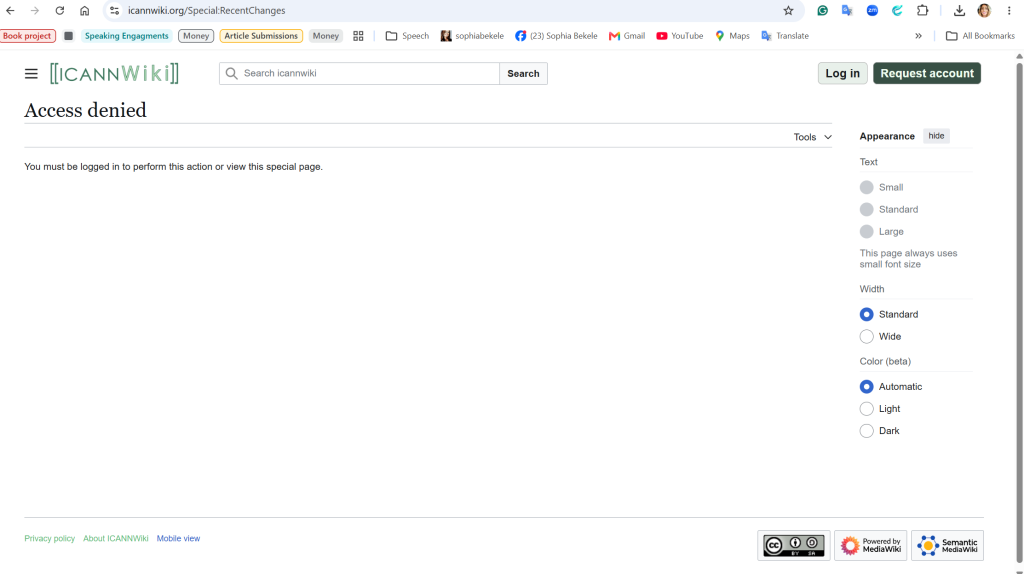
Screenshot of ICANNWiki showing ‘Access Denied’ message when attempting to view page history, with ‘Log in’ and ‘Request account’ options visible. System account access was requested online, but there was no response
The four recent publications below preceded the removal of substantial portions of the documented record. .
The timing of the revisions is equally revealing.
The revisions occurred shortly after these publications received public attention. Whether that timing was coincidental or responsive, the chronology is noteworthy
- Universal Acceptance Day and the Long Arc of Multilingualism (CircleID), documented a testimonial from pioneers of the IDRU (International Domain Resolution Union). That testimonial disappeared immediately after publication and was restored only after I requested a correction. The editor corrected part of the record but declined to fully restore it. That correction also reduced the solid testimonial to a “public praise”.
- Kenya Lost .africa. Here Is the Story The Citizen Kenya Left Out (LinkedIn), revisited how Kenya lost the .africa domain and documented key aspects of the institutional history surrounding the dispute, including the role of DotConnectAfrica’s former Chief Technical Officer, who later joined ICANN, together with events examined through the Independent Review Process and related legal proceedings. The article also highlights that the 2026 gTLD round is a financial and procedural minefield and not an easy road ahead.
- The Attention Economy Was Only the First Layer (LinkedIn) The Attention Economy Was Only the First Layer (LinkedIn) discussed the emergence of the Interest Economy. I referenced a recent case where a source cited that they used AI to analyze my public body of work, concluding that I was among the few practitioners able to speak on AI governance, Internet policy, and digital sovereignty from a position of direct institutional experience, also citing .africa as an example. Well, thank you, AI, for that affirmation. But in reaching that assessment, the AI cited my published work on LinkedIn, CircleID, and The Ethical Technocrat, without relying on or even referencing the ICANN Wiki or any Wiki biography. That reinforces where the most comprehensive and authoritative documented record of my work actually resides.
- Did the AUC-Aligned ZACR Actually Deliver .africa? (LinkedIn), shifted the discussion from historical process to measurable outcomes. It examined the registry’s performance after a decade of operation, documenting approximately 55,000 domain registrations serving a continent of 1.5 billion people, and asked a simple question: what exactly was the objective that justified choosing ZACR over DCA, and was it ever achieved?
Following these publications, ICANN Wiki removed approximately 90 percent of my documented biography as well as our company DotConnectAfrica. The original record has since been preserved through the Wayback Machine and republished on the respective sites as an archive.
The documented records in these publications include, at a minimum:
- Championing IDNs for the global language group, organizing the constituencies led by the IDN Pioneers, who came to me complaining about ICANN’s process and gave me testimonials for my leadership in ensuring the policy gets done—not “public praise” as ICANN Wiki revised it to be. I was also nominated to chair the ICANN IDN group as a result.
Championed .africa gTLD in a The 6-year successful and widely acclaimed Yes2DotAfrica campaign that raised awareness not just of .africa but of the ICANN gTLD program, making .africa one of the top 50 gTLDs by a reputable industry rating agency, with pre-registrations reaching 25,000.
Co-authorship of the 2012 New gTLD Applicant Guidebook and the successful challenge to its subsequent subversion by ICANN, through its own Independent Review Process (IRP) and related court proceedings.
Precedent-setting objections involving ICANN’s Independent Objector (IO), the Governmental Advisory Committee (GAC), and the IRP that reshaped ICANN’s own accountability mechanisms and that got cited by so many other IRPs afterwards and benefited the ICANN internet community.
Went to the US Congress, presented my testimony on ICANN’s accountability, and engaged until a hearing was conducted.
Court Litigation that defeated ICANN’s motion for summary judgment, overturning the applicant waiver ICANN required applicants to sign, preserving fraud-related claims for scheduled trial.
The only .africa application that followed the Applicant Guidebook as written, with no political influence. ICANN did not need to write an endorsement using the same format I had already prepared for the Geographic Names Panel behind the scenes. Instead, they used extended evaluation to force DCA to get support from the same organization that negotiated legal rights to .africa in exchange for endorsing ZACR.
The Difference Between Editing and Revisionism
No historical record is perfect. Corrections are necessary. New evidence emerges. Mistakes occur. Good editors improve history.
Revisionism is something different. Revisionism selectively changes historical understanding while leaving readers unaware that the underlying narrative has materially shifted. The distinction is subtle. Editing improves accuracy. Revisionism changes perception. Responsible governance requires systems capable of distinguishing between the two. That distinction will become increasingly important as AI systems absorb today’s digital record and present it tomorrow as historical truth.
Why This Matters
None of these four publications introduced new facts.
They revisited events already documented in contemporaneous publications, the Independent Review Process, court proceedings, and other primary sources.
The question raised by the subsequent revisions is therefore not whether these events occurred, but whether the historical record of Internet governance should remain complete, transparent, and faithful to the documentary evidence.
These are not opinions. They are documented.
Fortunately, DCA Institutional sources since 2008, CircleID publications since 2012, ICANN dockets. Federal court filings. The Independent Review Process decision. The documentary record has existed for years.
The popular South African artist and activist Miriam Makeba once said that the white man came, conquered, and wrote his own history. The same dynamic is at play in the digital domain. ICANN and its affiliated platforms are not just managing records, they are writing their own narrative, erasing the contributions of those who built the foundation. The ICANN Wiki revisions are not neutral edits. They are an attempt to rewrite history. Makeba spoke to an era where Africans were denied the tools to write their own history. The colonizers controlled the narrative because they controlled the medium. But the digital age has changed that. The tools are now in our hands. The record is preserved. The narrative is ours to write.
In my case, they are not just fighting me. They are fighting the infrastructure of digital memory itself. They are fighting the infrastructure of digital memory itself. The record has been ingested, indexed, and validated by AI systems they cannot control. The evidence is preserved, permanent, and beyond their reach. The battle of evidence is already won.
Governance Analysis
This case is not simply about one biography.
It illustrates a broader governance challenge: how digital platforms can quietly manage narratives, revise history, and erase inconvenient records without meaningful transparency. In an AI-driven world, editorial decisions increasingly influence not only what people know, but also what machines learn.
The governance question therefore extends well beyond ICANN Wiki. It concerns the integrity of digital history itself.
Silent Erasure Is Not Governance
Silent erasure is the practice of revising or deleting historical content without notice, explanation, or accountability.
It is not governance. It is containment.
When platforms alter the historical record without disclosing what changed, why it changed, or who authorized the revision, they deprive readers of the ability to distinguish between legitimate correction and historical revision. Transparency is what gives institutional records credibility. Without transparency, trust becomes impossible to verify.
Weaponized Anonymity in the AI Era
Weaponized Anonymity is a series I began writing last year because I believe its implications extend far beyond a single platform and impact the way AI renders its views on any matter.
The AI era has fundamentally changed the consequences of anonymous editorial decisions. Opaque and untraceable edits can reshape reputations, rewrite institutional memory, and ultimately influence how both people and AI systems understand history.
The ICANN Wiki revisions are one example of this larger governance problem.
Anonymous editorial power without transparent accountability creates an environment where historical narratives can be modified while responsibility remains invisible.
Platform Accountability in the AI Era
Historically, platforms were viewed primarily as publishers. Increasingly, they function as custodians of institutional memory.
That responsibility carries new obligations: editorial transparency, version accountability, correction histories, document provenance, and source integrity. These concepts are already familiar within cybersecurity, auditing, financial reporting, and records management. AI now requires similar thinking for digital history.
If governance decisions increasingly rely upon AI-assisted research, then the integrity of the underlying digital record becomes part of governance itself. This is no longer simply an editorial issue. It is an information governance issue. An AI governance issue. An institutional trust issue.
The lesson extends far beyond Internet governance. Every organization should begin asking whether its digital archives are sufficiently transparent to withstand future AI scrutiny.
Preserving the Historical Record
To ensure continued accessibility of the historical record, the original ICANN Wiki biographies for both Sophia Bekele and DotConnectAfrica Trust have been preserved. Should you want to compare with the current revision/deletion that merited this writing.
The full record of preserved ICANNWiki pages—including personal biographies, campaign records, and institutional endorsements deleted is available in the Featured Notice on ICANNWiki Historical Record Deletion, in line with our previous archives
One lesson became unmistakably clear throughout this experience: never rely upon a single platform to preserve your professional history. Primary documentation remains the strongest protection against institutional amnesia. Court records remain. Published articles remain. Conference presentations remain. Government submissions remain. Independent interviews remain. Books remain. Institutional archives remain. Those sources collectively create resilience. If one summary changes, the broader body of evidence continues to exist.
This became evident through the AI assessment discussed earlier. The AI reached its conclusions without depending upon the ICANN Wiki biography. Instead, it synthesized evidence from LinkedIn, CircleID, The Ethical Technocrat, conference presentations, governance publications, public interviews, DCA’s institutional documentation, and other primary sources accumulated over two decades.
That outcome reinforces an important governance principle: the most authoritative record is rarely a single profile page; it is the totality of independently verifiable evidence.
Larger Lesson
The ICANN Wiki case is not the story. It is the case study.
The larger issue is whether platforms that document Internet governance should themselves be governed by transparent editorial principles. As AI systems increasingly rely upon digital archives as factual sources, silent revisions no longer affect only today’s readers. They influence tomorrow’s research, journalism, policymaking, and machine-generated knowledge.
The ICANN Wiki revisions matter because they illustrate something much larger than one biography. They remind us that history is increasingly dynamic. Digital memory is no longer fixed. Institutional narratives evolve. Platforms change. Editors change. Organizations change. AI models change. What remains constant is documented evidence.
Digital sovereignty is not only about infrastructure. It is also about memory. Institutional resilience is not only about governance. It is also about documentation. Historical integrity is not only about facts. It is about preserving the evidence that allows future generations, and increasingly future AI systems, to understand those facts accurately.
Governance is no longer simply about how institutions make decisions. It is also about how institutions preserve history.
So, if your work matters, preserve your own evidence. Maintain your own primary sources. Archive your own publications.
Do not assume that third-party platforms will preserve your legacy with the same care that you would.
Transparency builds trust. Anonymity enables revisionism. Here is the documented record. The parties involved know it.
Now the governance community can examine it as a case study.
Hence, a message to the ICANN Wiki ‘Lead Engineer’: I know you claimed you dont know much about the past issues at ICANN, but this is not someone who just ‘participated’ in “IDN and .africa discussions” as ICANN Wiki wants to narrate for your new audience. When you grow up professionally, all these activities are called leadership, which cannot be usurped by ChatGPT politeness. Just to be clear, it is not my style to just ‘participate’ like the hundred profiles you set up that come to your boot. I take up a cause and champion it.
Voilà.
I welcome any comments on the contents above, especially from ICANNWiki editors and/or management.
#ICANN #ICANNWiki #DigitalGovernance #InternetGovernance #InstitutionalMemory #PlatformAccountability #DigitalSovereignty #Governance #AI #AIEthics #SilentErasure #WeaponizedAnonymity #DotAfrica #IDN #Transparency #History #Archive #Evidence #Leadership #Policy
Sophia Bekele
Internet Governance Pioneer | ICANN Reform Veteran
Founder, DotConnectAfrica Group & CBSegroup | Publisher, The Ethical Technocrat
Subscribe to The Ethical Technocrat →
The Counter-Playbook for leaders navigating power, platforms, and institutional risk