The old order is burning. Allies are realigning. Capital is walking. Is your board prepared?
March 14, 2026:
This article is part of the Governance, Democracy & Economic Policy Series →
The Pattern
The old assumption — that the United States would always be the center of global trade, security, and capital — is no longer reliable.
We are witnessing a structural realignment. Allies are building relationships that bypass Washington. This is not a collection of isolated events. It is a pattern with direct implications for corporate governance, capital strategy, and sovereign risk.
What’s Changing: A Snapshot
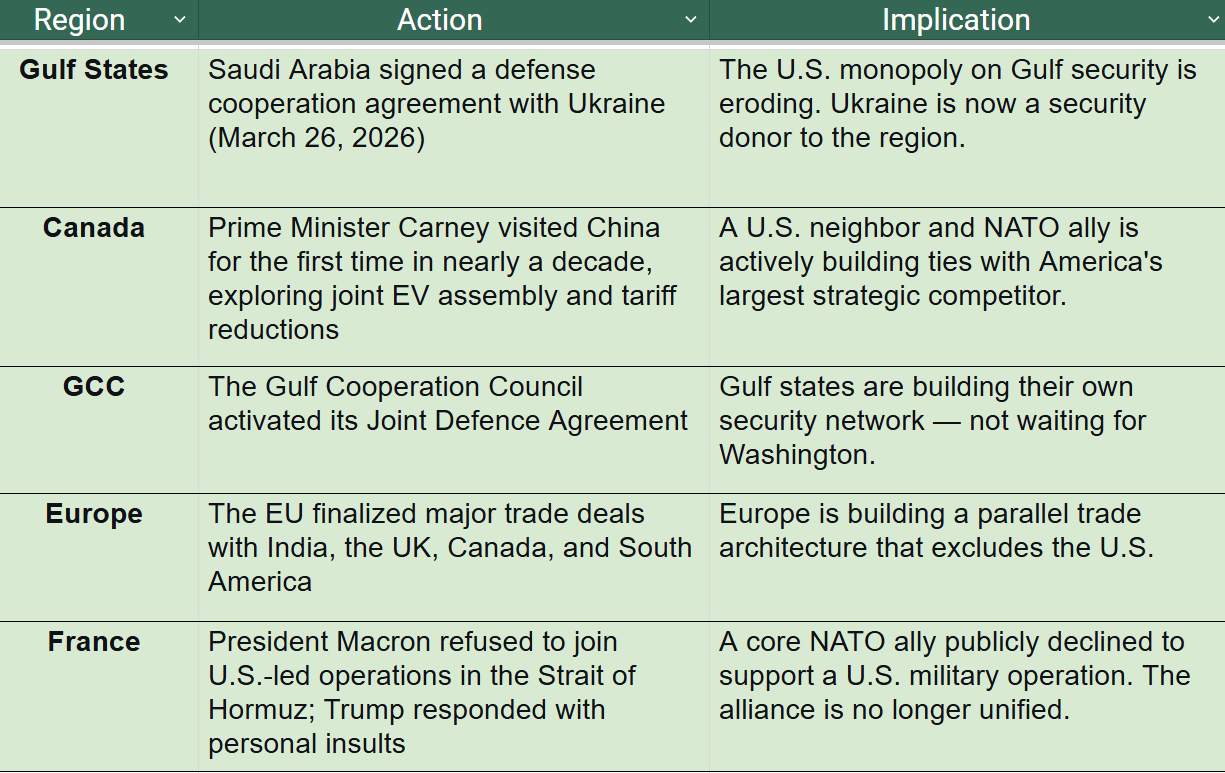
Sources: BBC News, CBC, S&P Global, Euractiv, News on Air — official statements and public reports, March–April 2026
Case Study: The Collapse of the Gulf’s Events Economy
The pattern is not abstract. It is visible in the region’s carefully curated calendar of business, finance, and sporting events, which has collapsed since late February:
-
Global Forums: The World Economic Forum in Jeddah was rescheduled indefinitely. Abu Dhabi Business Week was postponed.
-
Major Conferences: The Arabian Travel Market in Dubai was moved from May to August. A major crypto conference in Dubai was deferred by a full year to April 2027.
-
Sporting Events: The Bahrain and Saudi Arabian Formula 1 Grands Prix were cancelled. The “Finalissima” football match between Spain and Argentina in Doha was suspended.
-
Cultural Events: Art Dubai proceeded in an “adapted format” after its original plans were disrupted.
-
Energy Forums: The CEOs of Saudi Aramco and ADNOC both skipped the CERAWeek conference in Houston to remain in the region.
Two structural factors explain this freeze:
-
The Insurance Gap. War is now a “blanket exclusion” in travel and event insurance for the Gulf region. As one industry expert noted, “The insurance gap is not a sentiment problem. It is a balance-sheet constraint that operates independently of whether the security situation improves.” Without insurance, no event can proceed.
-
The Decoupling of Gulf Capital. Gulf sovereign wealth funds, projected to manage $7.3 trillion by 2030, are actively reorienting their strategies. European general partners are building dedicated co-investment vehicles to attract this capital, which is seeking stability outside the immediate conflict zone. The capital that once flowed to U.S.-centric events is finding other pathways.
The message for global executives is clear: the old map of global capital flows is being redrawn, and the reliability of the Gulf as a convening hub is no longer a given.
The Board’s New Question
The question is no longer “Are we compliant?”
It is “Are we prepared?”
Prepared for a world where:
-
Allies are no longer reliable
-
Capital is no longer loyal
-
Sovereignty is no longer a buzzword — it is a survival strategy
That’s the diagnosis. Now for the architecture — including the five risk areas every board must map, the scenario-planning framework, and how to build a geopolitical risk committee.
#TheEthicalTechnocrat #SovereigntyPremium #GeopoliticalRisk #BoardGovernance #AllianceBurning #CapitalFlight #DigitalSovereignty
Sophia Bekele
Digital Sovereignty Architect | AI Governance Strategist
Founder of DotConnectAfrica Group and CBSegroup, Ex Fortune 500 Tech Auditor and advisor to multiple UN bodies & ICANN. She is recognized as a pioneer of internet governance and a 2025 Global Champion of Digital Sovereignty. She advises boards and institutions on sovereign architecture, geopolitical risk, and strategic governance.
Subscribe to The Ethical Technocrat →
The Counter-Playbook for leaders navigating power, platforms, and institutional risk