March 29, 2026
This article is part of the Governance, Democracy & Economic Policy Series →
— Yet the Alliance Is Still Burning—The Children in the Room II
Prologue: The Template
In 2026, a pattern emerged. The U.S. president would announce a breakthrough — an ally agreeing, a deal close, a war nearly over. Within hours, sometimes minutes, the other side would say: that never happened.
This is the White House Template. Claim victory. Declare progress. Hope no one checks.
But people are checking.
Act I: Spain (March 9–12)
The U.S. needed bases to strike Iran. Spain refused.
“These bases will not be used for anything not in accordance with the UN Charter.”
Trump threatened to cut off all trade. The White House announced Spain had agreed to cooperate. Spain’s foreign minister called it “completely untrue.”
The template was set: claim an ally’s support; let the ally clean up in private.
Act II: Iran (March 18–25)
Trump announced “productive talks.” A deal was close. Iran wanted peace.
“We do not intend to negotiate,” said Iran’s foreign minister.
“Fake news,” said the parliament speaker.
A University of Tehran professor explained:
“Every week, when markets open, Trump makes these statements to drive down oil prices.”
The template was not about diplomacy. It was about markets.
Act III: Saudi Arabia (March 24)
Trump said Crown Prince Mohammed bin Salman was encouraging him to continue the war.
“He is a warrior. He is fighting with us.”
Within minutes, Saudi Arabia issued a formal denial:
“The claim is completely false and misleading.”
The template now had a five-minute turnaround.
Act IV: Qatar (March 21–26)
Qatar’s Emir warned Trump of “serious consequences.”
Then its Minister of Education delivered a public rebuke:
“STOP using us as an excuse for your sick destructive agendas. STOP your baseless claims that you want to liberate us. No one needs you to liberate them, we just need you to leave us alone.”
“It’s not our fault that you failed in school and received your education from Hollywood movies — the world is not a movie.”
The template had evolved: allies were no longer just denying. They were shouting.
Act V: The Final Act — Trump at FII (March 27)
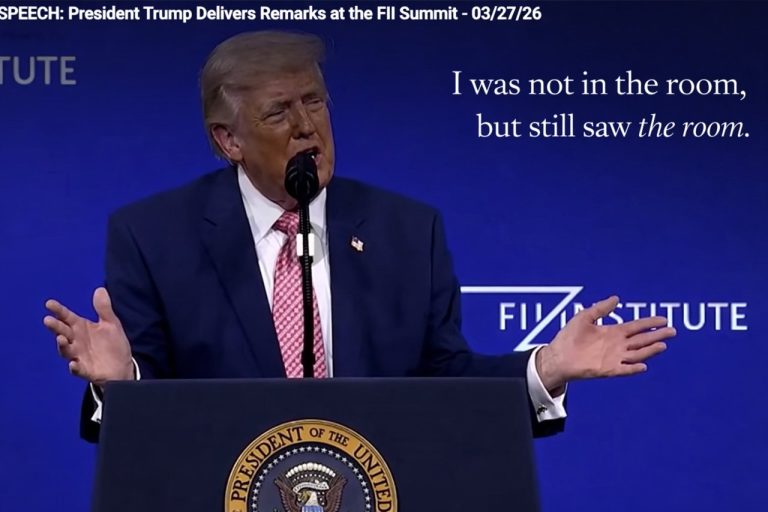
At the FII Miami summit, the president took the stage.
Semafor captured the surface this week:
“Wall Street’s moneymen still want to sit at the intersection of Middle East petrodollars and western capitalism. For now, though, they’d just rather do it from Miami.”
But look closer at the intersection.
The speaker list at FII Miami included no major Wall Street CEOs. No European leaders. No U.S. cabinet officials. The people who should have been in the room stayed home.
Why?
Because the intersection is on fire. Gulf capital is walking — $322 billion in Treasury sales in early 2026 alone. Allies publicly denied the White House’s claims in real time — Spain, Iran, Saudi, Qatar — each within hours, sometimes minutes.
Then Trump took the stage — and confirmed exactly why they stayed away.
The first word out of his mouth was:
“There are many rich people in this room – left, right and center, even all the way to the back.”
He was acknowledging the transaction. FII had pivoted to Miami to sell access to the high-net-worth crowd — the finance executives who had relocated there, the investors who filled the seats.
Then he boasted about a poll showing 100% approval among MAGA voters — a statistic CNN’s Harry Enten immediately qualified as 100% of the 30% of Americans who identify as MAGA supporters. He was sending a signal to the investors in the room: I am unshakable. Bet on me.
He then claimed Iran was “begging to make a deal” — a claim Iran denied before he finished speaking.
He renamed a strait after himself.
He threatened Cuba.
Then he told the room about a private conversation he had with Saudi Crown Prince Mohammed bin Salman:
“He said, ‘A year ago you were a dead country. Now you are the hottest country anywhere in the world.'”
Then came the line that would travel:
“He didn’t think this was going to happen. He didn’t think he would be kissing my ass. He really didn’t. He thought I would be just another American president that was a loser, where the country was going downhill. But now he has to be nice to me. You tell him: he’d better be nice to me. He’s got to be.”
Then, moments later, he called the Crown Prince a “fantastic man” and a “warrior fighting with us.” The ally who hosted the summit was praised, humiliated, and praised again — all in the same speech.
Then, as if to remind a room full of investors what kind of stage this really was, he added:
“You can ask me anything you want. You can talk sex. Whatever the hell you want.”
The room didn’t happen by accident.
It was engineered years in advance — and the engineering is documented.
In October 2022, FII Institute announced an exclusive membership program, effective January 2023, under which all its summits would only be accessible to paying members at $15,000 per year (FII Institute membership page).
That same month, former Miami Mayor Francis Suarez — working as a private attorney at the firm representing Saudi Arabia’s Public Investment Fund — extended a personal invitation to bring FII Priority to Miami for the first time. He helped open a Saudi investment office in the city. He positioned Miami as the gateway for Gulf sovereign wealth into the Americas. He left office in December 2025. Within weeks, he was named president of a Gulf-backed private equity firm.
Before the summit opened, House of Saud noted that the Faena Hotel — the most expensive venue on Miami Beach — signaled a target audience of:
“ultra-high-net-worth attendees and institutional investors rather than retail audiences.”
I recall that before FII was even formed, we were on PIF’s curated list — as innovators, nation builders, and policy advisors. That was the founding mission we publicly championed. But when they introduced their membership fees in Miami in 2024 and engaged with many of the participants, I already read the room.
The $15,000 membership fee was the filter — despite that the members are people who may not move institutional capital. And even paying it guaranteed nothing: FII’s own terms reserve the right to refuse any member entry, with fees non-cancellable, non-refundable, and non-transferable (FII Institute membership terms).
Past Miami editions drew 1,200 to 1,500. This year: 1,900. They invited me — and then cancelled my participation – citing “space limitationss”. even after I informed them of my flight and hotel booking, and even after learning that some of my colleagues were paying members — I graciously accepted, thinking it might be due to the Iraq war — only to learn later that the overcapacity of 1,900 rooms was curated to accommodate “Miami’s transactional new money” instead.
Capacity was never the constraint. Curation was.
Epilogue
The summit ended. No alliance was restored. The only headline was the performance.
They built the stage. They invited the actor. They paid for the production.
What they didn’t count on was the script.
Now the deeper question: what did the Gulf actually need from this room?
Not capital. The PIF manages nearly $1 trillion in assets. What it needs — urgently — is credibility. Saudi Arabia’s target is to attract $100 billion a year in foreign investment by 2030. According to AGBI, actual net inflows in the first nine months of 2025 were just $19 billion. PIF cash reserves had fallen to their lowest level since 2020, forcing cuts of up to 60 percent across project budgets, per The Saudi Times. One analyst close to the process told AGBI:
“This is all going to come down to perception and how the market reads it.”
Perception. Not fundamentals
This is why the deals showcased at FII Miami — HUMAIN, Saudi Eksab, the Patel Family Office / AHQ hospitality platform — were chosen carefully. These are not independent companies seeking outside capital on their merits. They are Saudi-linked vehicles.
When a Miami investor buys in, it creates the appearance that private capital is independently choosing Saudi opportunities.
That appearance is the product
As one analyst documented, the Gulf’s investment strategy has always been as much about projecting influence as generating returns — soft power that no lobbying firm could manufacture at any price.
The Miami investors in that room — many of them asset managers attending as individuals — are not buyers of an opportunity. They are the proof of concept: evidence that the room works, not that the deals will follow.
In the end, that question belongs to the investors — and the answer depends entirely on whether they ask it before or after they sign.
And the former mayor?
He was never simply an ambassador for Miami. He was the advance man for a market entry that would always reward him once his public role was done. He delivered the room. The room delivered him his next career.
Meanwhile, Miami elected Eileen Higgins — a Democrat who rejected Trump’s endorsed candidate by 20 points and promised to clean up the city’s ethics.
Reading the post-summit FII report confirmed it.
The Wall Street heavyweights announced before the summit were nowhere in the official record. Trump received a full chapter — but sanitised beyond recognition. The lines that travelled around the world did not appear.
The room was curated for perception, not presence.
And then something telling happened.
Their own post-summit report quietly pivoted back to innovators, policymakers, changemakers — the language of their founding mission. Africa gets a chapter. Sierra Leone’s president gets quoted. Latin America development language returns. The investor-heavy framing quietly disappears.
That pivot is not a coincidence. It’s institutional course correction. They saw how the room looked from outside — and they didn’t like the reflection.
The circuit was always burning.
The pattern is complete. The alliance is still burning.
The capital is walking. But maybe the lesson is this: when you lend your stage to someone else’s story, you don’t control how it ends.
Miami voted for competence. FII curated for cash. Higgins won. Suarez profited. Trump humiliated.
I was not in the room, but still saw the room.
— legacy built on truth — not access
#TheWhiteHouseTemplate #TheChildrenInTheRoomII #AllianceBurning #FIIMiami #PatternRecognition #IranWar #CapitalFlight #SovereigntyPremium #GeopoliticalRisk #LegacyBuiltOnTruthNotAccess #StillWriting
Sophia Bekele
On Law, Governance, and the Architecture of Power
Founder, DotConnectAfrica Group & CBSegroup | Publisher, The Ethical Technocrat
Article also published on Substack: Subscribe to The Ethical Technocrat →
The Counter-Playbook for leaders navigating power, platforms, and institutional risk