Published First on Linkedin
Part of the ICANN & Governance Series
What Every 2026 gTLD Applicant Should Know Before Entering the Game
A note to readers:
I want to bring ICANN to the public square. It has been an industry widely unknown, operating eccentrically in its own bubble where checks and balances seem to exist only within its own ecosystem. So here we are: governance professionals, business leaders, communities, and decision-makers, invited to audit, query, and see for yourself.
This is the first in a series. I have been in this fight longer than most people have even known this fight existed.
What ICANN, Consultants, and Lawyers Won’t Tell You
— By Sophia Bekele
A note to readers:
I want to bring ICANN to the public square. It has been an industry widely unknown, operating eccentrically in its own bubble where checks and balances seem to exist only within its own ecosystem. So here we are: governance professionals, business leaders, communities, and decision-makers, invited to audit, query, and see for yourself.
This is the first in a series. I have been in this fight longer than most people have even known this fight existed.
I Called This a Decade Ago
The FIFA crisis is not just a parallel; it is a living example of institutional failure. This is not a new comparison for me, however. Back in June 2015, weeks after FIFA president Sepp Blatter resigned in the middle of a US Department of Justice corruption indictment, I wrote publicly that ICANN was walking the exact same path.
In 2015, I wrote that ICANN was walking the same path as FIFA. In 2026, the path is still being walked by both institutions.
“Only proper regulation by an independent agency with full Congressional mandate will ensure that a ‘FIFA-Mafia type’ organization of systematic corruption does not emerge. ICANN should not be trusted by Congress to regulate itself.” Sophia Bekele, June 2015 — Read the full article on CircleID
What ICANN, Consultants, and Lawyers Won’t Tell You
— By Sophia Bekele
A note to readers:
I want to bring ICANN to the public square. It has been an industry widely unknown, operating eccentrically in its own bubble where checks and balances seem to exist only within its own ecosystem. So here we are: governance professionals, business leaders, communities, and decision-makers, invited to audit, query, and see for yourself.
This is the first in a series. I have been in this fight longer than most people have even known this fight existed.
I Called This a Decade Ago
The FIFA crisis is not just a parallel; it is a living example of institutional failure. This is not a new comparison for me, however. Back in June 2015, weeks after FIFA president Sepp Blatter resigned in the middle of a US Department of Justice corruption indictment, I wrote publicly that ICANN was walking the exact same path.
In 2015, I wrote that ICANN was walking the same path as FIFA. In 2026, the path is still being walked by both institutions.
“Only proper regulation by an independent agency with full Congressional mandate will ensure that a ‘FIFA-Mafia type’ organization of systematic corruption does not emerge. ICANN should not be trusted by Congress to regulate itself.” Sophia Bekele, June 2015 — Read the full article on CircleID
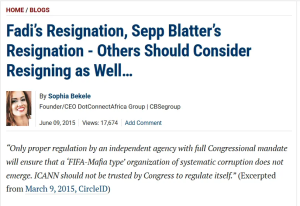
I called for ICANN’s CEO, its Board Chairman, and the NTIA Administrator overseeing the transition to all step down. Blatter resigned within days. Chehadé resigned too. The other two did not. They served their term. The ICANN CEO and Chairman showed up for DCA deposition. But the NTIA head at the time – the one who ensured ICANN’s transition out of U.S. oversight – dodged ours a dozen times.
So yes, I said it a decade before it was fashionable to make this comparison.
How I Ended Up Here
Here is the part most people do not know. When the New gTLD expansion started, ICANN wanted to blow open the root zone, move past .com, .org, .net, and let anyone claim a piece of the internet as their own ending. Brands. Cities. Communities. All of it. Everyone in that space was genuinely excited. I was too.
I got appointed as one of the high-level policy advisors helping shape the program. I co-authored the rules in the 2012 New gTLD Applicant Guidebook. I took on championing .africa from the inside, because if anyone was getting a piece of digital real estate that big, Africa deserved one too. No one was paying attention to it. My reasons were justified. .Asia and .EU was done already, and .LAT was doing it in parallel to me. What happened after that is one of the longest fights in internet governance history. I have written the full account in my upcoming book, Black Swan Moments: Nerves of Steel.
That is not what I am here to tell you today.
Same Pattern, New Jersey
ICANN is opening up a new round of gTLD applications again after almost a decade. The pitch sounds exciting. Own your brand as a domain. Secure your digital territory. Own your corner of the internet forever.
I have heard this pitch before. I believed it once too.
Here is what nobody tells you upfront: the technology works fine. The governance does not. And that gap is where your money, your years, and your sanity go to die.
I know because I lived it. My fight for .africa took over a decade. An Independent Review Process. A federal lawsuit. A legal doctrine most applicants have never heard of. I won, legally, on the merits. And ICANN still found a way to make sure I never got what I won.
FIFA STILL IS IN THE HEADLINES AFTER GAME IS OVER:
So let us talk about FIFA for a moment, because the comparison is no longer mine alone. The technology at this World Cup is precise—connected balls, sensors that catch contact invisible to the human eye. And still, match after match, the same countries keep getting burned by the same pattern. Croatia. Egypt. Senegal. Iran. Norway. The tech works. The governance around it does not, and everyone watching can feel it.
The crisis at FIFA is still unfolding. In 2026, its president, Gianni Infantino, faced widespread calls for his resignation over a failed plan to sell a stake in the World Cup to private investors. UEFA, the Asian, and North American confederations accused the leadership of a ‘fundamental breach of trust,’ and U.S. President Donald Trump has publicly backed him, warning FIFA against his removal. The confederations are now split, with the crisis exposing the same culture of impunity you identified a decade ago.
That is not a football problem. That is an institutional problem wearing a football jersey.
The Winners at ICANN Are Not Even Using What They Won
ICANN is the same story in a different jersey. And here is what should actually worry you if you are thinking about applying in 2026: even the applicants who won clean, no fight, no controversy, are not using what they won.
Google has owned .google since 2012. Thirteen years later, it has 256 registered domains. Employees only. Nobody else can touch it.
Amazon fought for seven years just to be allowed to use .amazon, and today it is locked down, internal, invisible to the public.
Compare that to genuinely open extensions like .shop, sitting at over 1.5 million registrations, or .top, past 2 million. Anyone can register those. Almost nobody can register a domain on .google or .amazon at all.
Meanwhile, the real money paid for real exclusivity that mostly just sat there.
Maserati got theirs. Abandoned it. Mont Blanc, same story. Zippo, MetLife, dozens more. All paid. All walked away with nothing to show for it.
Same Pattern, New Jersey
ICANN is opening up a new round of gTLD applications again after almost a decade. The pitch sounds exciting. Own your brand as a domain. Secure your digital territory. Own your corner of the internet forever.
I have heard this pitch before. I believed it once too.
Here is what nobody tells you upfront: the technology works fine. The governance does not. And that gap is where your money, your years, and your sanity go to die.
I know because I lived it. My fight for .africa took over a decade. An Independent Review Process. A federal lawsuit. A legal doctrine most applicants have never heard of. I won, legally, on the merits. And ICANN still found a way to make sure I never got what I won.
FIFA STILL IS IN THE HEADLINES AFTER GAME IS OVER:
So let us talk about FIFA for a moment, because the comparison is no longer mine alone. The technology at this World Cup is precise—connected balls, sensors that catch contact invisible to the human eye. And still, match after match, the same countries keep getting burned by the same pattern. Croatia. Egypt. Senegal. Iran. Norway. The tech works. The governance around it does not, and everyone watching can feel it.
The crisis at FIFA is still unfolding. In 2026, its president, Gianni Infantino, faced widespread calls for his resignation over a failed plan to sell a stake in the World Cup to private investors. UEFA, the Asian, and North American confederations accused the leadership of a ‘fundamental breach of trust,’ and U.S. President Donald Trump has publicly backed him, warning FIFA against his removal. The confederations are now split, with the crisis exposing the same culture of impunity you identified a decade ago.
That is not a football problem. That is an institutional problem wearing a football jersey.
The Winners at ICANN Are Not Even Using What They Won
ICANN is the same story in a different jersey. And here is what should actually worry you if you are thinking about applying in 2026: even the applicants who won clean, no fight, no controversy, are not using what they won.
Google has owned .google since 2012. Thirteen years later, it has 256 registered domains. Employees only. Nobody else can touch it.
Amazon fought for seven years just to be allowed to use .amazon, and today it is locked down, internal, invisible to the public.
Compare that to genuinely open extensions like .shop, sitting at over 1.5 million registrations, or .top, past 2 million. Anyone can register those. Almost nobody can register a domain on .google or .amazon at all.
Meanwhile, the real money paid for real exclusivity that mostly just sat there.
Maserati got theirs. Abandoned it. Mont Blanc, same story. Zippo, MetLife, dozens more. All paid. All walked away with nothing to show for it.
The Seal Already Moved On
And here is what nobody wants to say out loud: the seal of legitimacy everyone paid a fortune for in 2012 has already moved on without them.
Today it is .ai. Over a million registrations and counting, up from just over a hundred thousand five years ago. Register in .ai and people assume you are building something real. Register your own name as a dotBrand and most people will not even notice.
The legal protection people assume they are buying with a dotBrand, they already had it. Decades ago, I registered CBSInternational.com, now rebranded to CBSegroup, for my own business, matching the name of a local company, CBS, my father was invested in for my interest in Addis Ababa. The US media company CBS’s lawyers wrote to me claiming rights to it. My answer was simple: I had it first, legitimately, in active use. Go talk to ICANN. That was the end of the conversation.
Trademark priority follows genuine first use in commerce, not which ending sits after the dot. A dotBrand does not buy you protection you did not already have. It buys you an ending, nothing more.
The product nobody names
Nobody at ICANN has ever had to answer for how many of those dotBrands turned out to be worth what companies paid for them. The fee gets collected whether you use what you bought or let it die quietly. That is not a partnership. That is a toll booth with no obligation to tell you what is on the other side of the bridge.
The WAIVER TRAP
When you apply for a gTLD, ICANN makes you sign a waiver. You give up your right to sue them. In return, you get a review process, with their own “Independent Review Process” that they treat as optional. They do not have to follow it. We won ours. Amazon won theirs, and so many others. It did not matter.
We tried to hold them accountable for fraud-related claims regarding the way they treated our application. We defeated their motion for summary judgment, overturned the applicant waiver, and preserved a Jury trial. Then a procedure no one had heard of—”Judicial Estoppel”—stopped us. They finally succeeded when they used our own IRP lawyer’s words against us: “...that DCA has only the IRP forum for relief...” They argued that this statement was inconsistent across two different forums. One single statement, contested by two different judges, by the way, blocked us from ever having our day in court.
Two years of procedural litigation. Not a single day on the merits.
Bottom line: ICANN could not face DCA’s fraud allegations, so it used procedural maneuvering to shut the courtroom door
This is the architecture of impunity. ICANN makes you sign away your right to a real remedy, promises you a process that is not actually binding, and then uses your own good-faith participation in that process to block you from ever getting justice.
That is not a process. That is a trap.
Who Can Actually Afford This Game
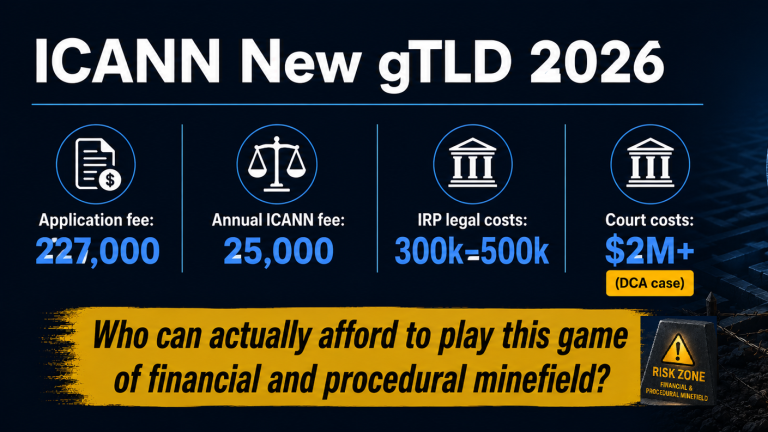
Before you file anything in 2026, ask yourself the only question that actually matters: who can afford to play this financial and procedural minefield? I laid out this full breakdown recently in response to a Kenyan outlet encouraging local companies to apply, worth reading if you want the full context: LinkedIn or Substack.
Application fee (standard): $227,000
Application fee (community, 80% reduction)~$45,400
Annual ICANN registry fee$25,000 / year, forever
Legal costs if disputed$300,000 – $500,000
Legal costs if it goes to court: No ceiling. Mine crossed $2 million plus.
Different Institutions, Same Failure
I left the corporate world because I could not breathe in it.
All the language, all the process, all the meetings about meetings, while the people actually harmed by these institutions never get a straight answer. I have watched this exact pattern play out many times, in business, in large government engagements, and on a football pitch in front of a billion people. Different institutions. Same failure.
If you have read this far and you are still thinking about applying for your dotBrand, you are either brave or unaware. I hope you are brave. But I also hope you are informed.
And if you do decide to file, know your rights, including the right to withdraw. The process is designed to trap you, not to help you succeed. Know the rules before you play the game.
I spent fifteen years documenting exactly what that fight actually costs, in money, in time, and in things nobody warns you about until you are already in too deep.
For the documented record behind the .Africa case — from the AUC process and ICANN evaluation to the landmark IRP victory, litigation, and its continuing governance implications — visit the .Africa Commentary Series.
More in this series to follow. ICANN is now in the public square.
#FIFA #ICANN #TLDTrap #GTLD #GovernanceRisk #DotConnectAfrica
Sophia Bekele — ICANN gTLD Policy Advisor (2005–2007) | Author, Black Swan Moments: Nerves of Steel | ⚽ FIFA, ICANN and the TLD Trap — What ICANN, Consultants, and Lawyers Won’t Tell You.
Subscribe to The Ethical Technocrat →
The Counter-Playbook for leaders navigating power, platforms, and institutional risk